
Rib Cartilage Rhinoplasty: The Truth Few Tell in Full
Have you had rhinoplasty before, only to be left with a red, shiny tip, a visible implant edge, or contraction and deformity? Or is your nose very low, with thin tip skin, multiple prior surgeries, and no longer enough septal cartilage left to rebuild? These are exactly the situations that make many people fear their nose is "beyond saving." In reality, reconstructive aesthetic medicine offers a solution designed for difficult cases: rib cartilage rhinoplasty. This article helps you understand the true nature of the technique, who genuinely needs it, and what to weigh carefully before placing your trust in a major operation.
Why did rib cartilage rhinoplasty come about?
The nose is built from a bony framework above and a cartilaginous framework below. When the nose is augmented with a synthetic implant alone, or when local autologous cartilage (septal cartilage, conchal ear cartilage) is no longer sufficient, the nasal columella lacks a solid point of support. The common consequences are a sinking dorsum, a deviated columella, or tip skin that gradually stretches thin over time.
Rib cartilage is an abundant, sturdy source of autologous tissue that can be shaped into many different grafts: a supporting strut (caudal septal extension graft), a tip onlay graft, or a base for dorsal augmentation. Because it is the body's own tissue, rib cartilage has high biocompatibility and reduces the risk of rejection compared with synthetic material. This is why the technique is regarded as one of the foundational options for complex reconstructive cases.
Who is rib cartilage rhinoplasty suitable for?
Not everyone needs rib cartilage. This method is usually considered for cases that genuinely have an indication, such as:
- A nose operated on multiple times, with fibrotic scar tissue and a shortage of local cartilage to build a strut.
- Complications from a previous augmentation: a visible implant edge, redness, tip contraction, or a deviated columella.
- A nose that is very short or significantly upturned and needs substantial tip lengthening.
- Thin tip skin that requires a natural, structurally durable supporting framework.
How does the rib cartilage rhinoplasty procedure work?
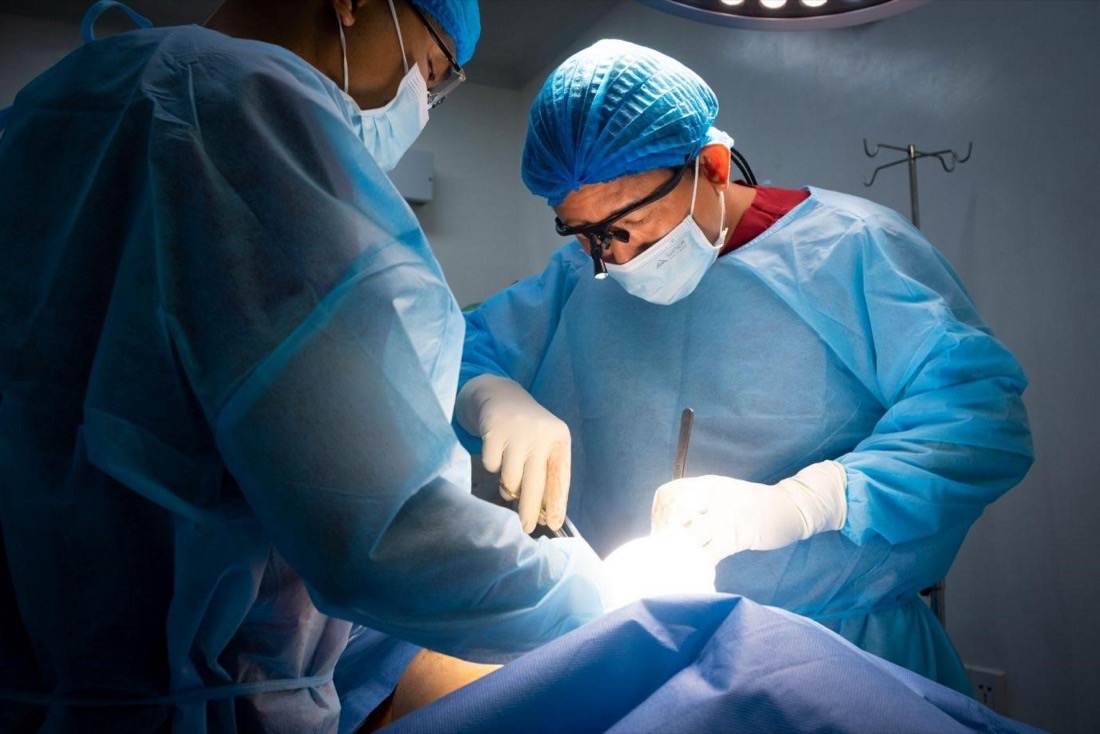
The surgery is performed in a sterile environment meeting hospital standards, usually under general anesthesia. The surgeon harvests a segment of rib cartilage (commonly the 6th or 7th rib) through a small incision hidden in the inframammary fold. Once harvested, the cartilage is meticulously carved into grafts designed individually for each nasal shape.
An important scientific principle is the technique for managing the warping tendency of rib cartilage. Surgeons often let the cartilage soak and stabilize for a period before placement, or use a balanced core-graft technique to limit later deformity. The supporting framework is firmly fixed to the nasal structure, helping the nose hold its shape more stably, depending on each individual's physiology.
The practical benefits the method can offer
When correctly indicated and performed by an experienced surgeon, rib cartilage rhinoplasty can deliver certain values that other materials struggle to achieve:
- A sturdy autologous supporting framework, suitable for noses needing major reconstruction.
- A reduced risk of a visible implant edge or redness, which are associated with synthetic cartilage placed in the wrong layer.
- A more natural tip feel, thanks to the covering tissue being the body's own cartilage.
- Flexible capacity to lengthen and shape the tip in difficult cases.
It must be emphasized: results vary by individual and require a direct examination for accurate assessment. There is no single nasal shape that is "right" for every face.
Common misconceptions that need clarifying
Many people believe that "rib cartilage will hold its shape forever and never change." This is an inaccurate notion. Rib cartilage is living tissue and may still undergo slight changes over time, depending on the surgeon's warping-management technique. Some also think that "harvesting rib cartilage will affect breathing or the chest wall" — in reality, the segment removed is very small and does not compromise the supporting function of the rib cage, though the harvest site will leave a small scar. Understanding this correctly helps you set reasonable expectations rather than trusting exaggerated advertising.
Medical notes: contraindications and normal side effects
Rib cartilage rhinoplasty is a major intervention, so thorough pre-operative screening is needed. The method is often unsuitable or should be postponed for people who: have a bleeding disorder, uncontrolled diabetes, an active nasal infection, are pregnant or breastfeeding, have an unstable underlying condition, or hold unrealistic aesthetic expectations. The assessment of physiology, cartilage quality and surgical history must be carried out directly by a specialist surgeon.
After surgery, some reactions are normal and will gradually subside: swelling around the nose, bruising around the eyes, mild tightness at the rib harvest site, and a feeling that the tip is still firm in the early stage. The nose needs many months for its shape to stabilize. However, if you experience a high fever, increasing pain, abnormal discharge, or signs of infection, you should contact your doctor immediately for prompt management.
Factors that affect the cost
The cost of a rib cartilage rhinoplasty depends on many factors: the complexity of the case (a first-time operation versus a revision), the condition of the cartilage and scar tissue, the warping-management technique, the type of anesthesia, and the facility where it is performed. Because this is an individualized surgery, the cost should only be discussed transparently after a direct examination — avoid trusting baseless "all-inclusive" figures.
Conclusion
Rib cartilage rhinoplasty is a reconstructive solution for difficult noses, using autologous tissue to build a sturdy, natural supporting framework. It is not the default choice for everyone, but an option with a clear medical indication that demands skill and careful assessment. Results always vary by individual and need a direct examination to be individualized.
If you are wondering whether your physiology is suitable for rib cartilage rhinoplasty, please register for a free consultation and physiology screening with a specialist surgeon. Here, the doctor personally examines, advises and operates in a hospital-standard environment (not a spa), with transparent costs.
Dr. Vo Thanh Sang, MD — Specialist Level I in Plastic and Aesthetic Surgery, over 15 years of experience, 12,000+ clients. Head of the Aesthetic Surgery Unit at World Wide Hospital. License 050864/HCM-CCHN. Address: 244A Cong Quynh, District 1, Ho Chi Minh City. Hotline: 079 7479 222.